


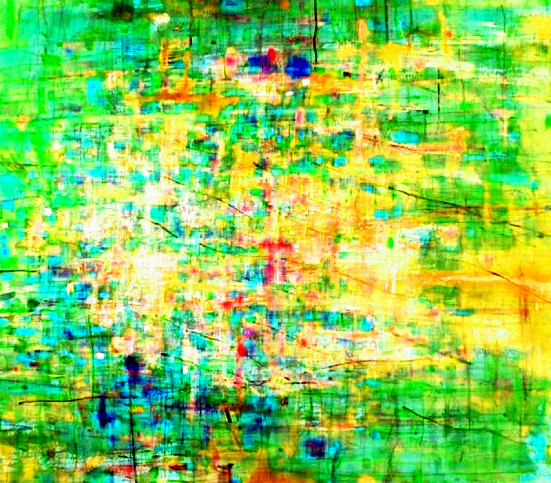
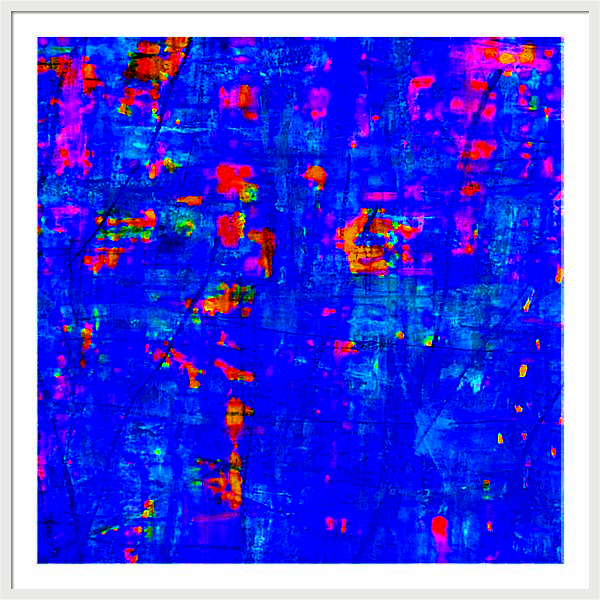



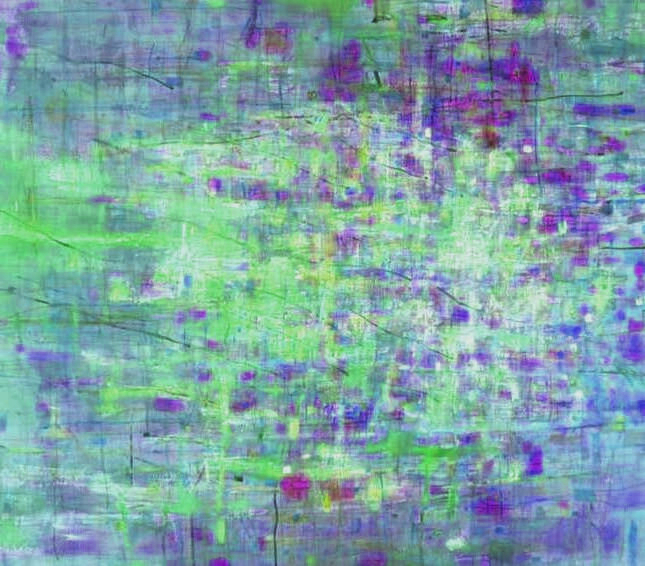


Water Lilies # 1 , Acrylic, gouache, felt marker, ink, watercolour, pen, watercolour pencil on canvas, 96 in x 121 in, 2011 photographed + photoshoped + reprinted , 30 in x 40 in, glicee on paper, 2019.


The Water Lilies by Claude Monet
Sections
History of the Water Lilies cycle
Texte
Offered to the French State by the painter Claude Monet on the day that followed the Armistice of November 11, 1918 as a symbol for peace, the Water Lilies are installed according to plan at the Orangerie Museum in 1927, a few months after his death. This unique set, a true « Sixtine Chapel of Impressionism » in the words of André Masson in 1952, testifies to Monet’s later work. It was designed as a real environment and crowns the Water Lilies cycle begun nearly thirty years before. The set is one of the largest monumental achievements of early twentieth-century painting.
Read more
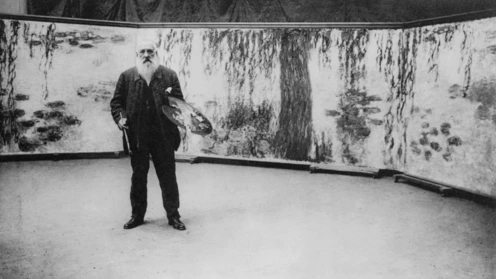
© DR
Claude Monet, the impressionist of the landscape
Texte
Claude Monet was born in Paris and grew up in Normandy in the town of Le Havre. He was introduced to the representation of nature in painting through contact with the painter Eugène Boudin (1824-1898). He arrived in Paris in 1859 and entered the studio of Charles Gleyre (1806-1874), where he made the acquaintance of the painters Pierre-Auguste Renoir (1841-1919), Alfred Sisley (1839-1899) and Frédéric Bazille (1841-1870). Edouard Manet influenced him in the early 1860s, while he was developing more personal landscapes.
The eight compositions of the Water Lilies
Oeuvres Reflets d’arbres Les Nuages Le Matin clair aux saules Les Deux Saules Soleil couchant Reflets verts Matin Le Matin aux saules
Although harshly criticized at the time it appeared, Impressionism was the first art movement in history that was truly modern for its rejection of the inherited representational canons and painterly styles, as well as for the introduction of innovative tactics such as the artist’s behavior and lifestyle, important aspects that became inseparable from their artistic practices.

The founding father of this influential movement, Claude Monet introduced the fascination with the light and its changing qualities, and unusual visual angles as the main ideas expressed through en plein air landscape painting by himself and other proponents. His revolutionary style came to a peak in the early 1970s, with the iconic painting Impression, Sunrise after which the movement received its name, however, it is another work of his that made him entirely established or rather a series he has been working on for thirty years – Monet’s Water Lilies.
Giverny – The Utopia After Monet
In 1883 Monet and his large family rented the large estate located between the towns of Vernon and Gasny at Giverny that included a doubled barn used as a painting studio, orchards, and a small garden. The artist’s career rapidly grew as he started to sell his paintings, and in late 1890, Monet was able to buy the estate including the land for his gardens. The same year the family built a greenhouse and a second studio lit with skylights.
Monet’s interest in horticulture expanded after 1893 when he bought a surrounding land with a pond that eventually became the water lily garden. With the help of a small group of gardeners, the artist diverted a river, planted water lilies, along with other plants such as weeping willows, bamboo trees, and exotic flowers. Ultimately, the creation of this mesmerizingly beautiful, dreamlike landscape was affiliated with Monet’s desire to organize his property as a huge painting.
Monet started painting the water lilies in 1899, initially in vertical views with the Japanese bridge as a dominant motif and later in the series of large-scale. Throughout his lifetime, he painted more than two hundred paintings featuring this motif.

The Renowned Monet’s Water Lilies
The first Water Lilies series consisting of twenty-five canvases we shown in 1900 at the Galerie Durand-Ruel in Paris. Nine years later Monet finished the second series of forty-eight canvases. To host permanently eight water lily murals during the 1920s the French state built two oval rooms at the Musée de l’Orangerie, but the exhibit opened in 1927, just a few months after Monet’s death. In 1999 for a special exhibition at the same museum, sixty Water Lilies paintings were displayed.
The paintings can be found at museums all over the world, including the Musée d’Orsay in Paris, the Metropolitan Museum of Art, Museum of Modern Art in New York, the Saint Louis Art Museum, the Carnegie Museum of Art, the National Museum of Wales, the Musée des Beaux-Arts de Nantes, to mention a few.
The Water Lilies series set new perimeters for the modern expression, especially abstraction, and became not only Monet’s best-known works, but also the most influential series of the first half of the 20th century.
To bring you closer to the series we decided to present in chronological order ten exceptional examples of Monet’s Water Lilies that are held in the world’s leading collections.
A gorgeous new edition with the cover printed on silver. Towards the end of his life and much inspired by Japanese water gardens, Monet spent a great deal of time in his beloved Giverny. Adorned with poppies, blue sage, dahlias and irises, the waters were disturbed only by bamboos and water lilies. His water garden was originally created to satisfy a need to be near water, and to provide a visual feast that could be enjoyed from his house. The pond was fed by the river Ru, and weeping willow and silver birch hung over its edges, caressing the fronds of the greenery and blossoms below. Its famous green wooden footbridge was built across the water and it became the central focus of many of his works. He said, ‘It took me some time to understand my water lilies. I planted them for pleasure.’ and so he began to work on what is probably the most famous series of paintings the world has ever seen.
Featured image: Claude Monet – Water Lilies, between 1917 and 1919. Oil on canvas. Collection Honolulu Museum of Art. Image creative commons.

Nympheas, 1897 – 1898
One of the first paintings featuring water lilies was made between 1897 and 1898, and it set the standard for the exploration of this motif. This particular version centered on the floating water lilies and their reflections is untypical from the rest of the early works for its horizontal format.
The painting Nympheas is held at the Los Angeles County Museum of Art.
Featured image: Claude Monet – Nympheas, between circa 1897 and circa 1898. Oil on canvas. Height: 26 in (66 cm); Width: 41 in (104.1 cm). Collection Los Angeles County Museum of Art. Image creative commons.

Claude Monet

The Water-Lily Pond, 1899
The second canvas on our top list was made by the artist in 1899 when he started a series of eighteen depictions of the wooden footbridge over the pond that summer. Focused on the pond with bridge, water plants, and surrounding trees the composition is divided by a fixed horizon. As the following works will show, throughout the time Monet became less and less interested in conventional pictorial space that has become a site for experimentation.
The Water-Lily Pond is part of The Metropolitan Museum of Art collection.
Featured image: Claude Monet – The Water-Lily Pond (also known as Japanese Bridge), 1899. Oil on canvas. Height: 92.7 cm (36.4 in); Width: 73.7 cm (29 in). Collection Metropolitan Museum of Art. Image creative commons.

The Water-Lily Pond, 1900
The Water-Lily Pond is a painting produced in 1900 and is part of the first group of works devoted to this particular motif Monet devotedly explored in his garden. Like the previous work, it also features the Japanese bridge surrounded by the wisterias planted by Monet. This structure was built by a local craftsman, however, by the time the garden was restored the bridge was too damaged and had to be rebuilt.
This artwork is held at the Museum of Fine Arts Boston Collection.
Featured image: Claude Monet – The Water-Lily Pond (also known as Japanese Bridge), 1900. Collection Boston MFA. Image creative commons.

Water Lilies, 1906
This version of Claude Monet’s Water Lilies made in 1906 belongs to the second series of forty-eight canvases that Monet finished three years later. This canvas perfectly illustrates the artist’s perception and the way he focused solely on the surface of the pond amid the reflection of the sky and trees. In 1908, the artist wrote:
These landscapes of water and reflection have become an obsession. This is beyond the strength of an old man, and yet I want to express what I feel. I have destroyed some of the canvases. I begin once again. … I hope something will come of all this effort.
The Water Lilies is held at the Art Institute of Chicago collection.
Featured image: Claude Monet – Water Lilies, 1906. Oil on canvas, 89.9 × 94.1 cm (35.3 × 37 in). Collection Art Institute of Chicago. Image creative commons.

Water-Lilies, Setting Sun, circa 1907
The painting Water-Lilies, Setting Sun depicts the reflection of the yellow and pink rays of the setting sun in the still water, along with the elongated branches of a weeping willow, and lilies drifting on the water’s surface. Interestingly so, the painting was still in Monet’s studio in 1923 when he sold it to an art dealer along with a couple of other works. At the time he was preparing to undergo a cataract operation, and so he asked to keep Water-Lilies, Setting Sun for a while to observe it or perhaps work after it with renewed sight.
Water-Lilies, Setting Sun is held at the National Gallery collection.
Featured image: Claude Monet – Water-Lilies, Setting Sun, circa 1907. Oil on canvas. Height: 73 cm (28.7 in); Width: 92.7 cm (36.4 in). Collection National Gallery. Image creative commons.

Nymphéas, 1914-1917
In 1911 Monet’s second wife Alice died, and only three years later Monet was able to get back to his water lily paintings. His approach shifted, especially when it comes to the canvas size which became monumental in scale. The palette changed as well and the artist started using spots of color to accentuate the flowers. Other artists such as Paul Cezanne, the notable practitioner of Post-impressionism, and Henri Matisse, the first of the Expressionists, were dazzled by these innovations.
This version of Nymphéas is held at the National Gallery of Australia collection.
Featured image: Claude Monet – Nymphéas, c.1914-17. Oil on canvas. Height: 1,810 mm (71.25 in); Width: 2,016 mm (79.37 in). Collection National Gallery of Australia. Image creative commons.
Works by Claude Monet
(Showing 20 of 20 works)


Not on display


La Pointe de la Hève, Sainte-Adresse
Not on display


Not on display

The Petit Bras of the Seine at Argenteuil
On display elsewhere

Not on display


Not on display